

Top Alternatives to Notion Client Portals
- 7 Min read
Gong is one of the leading Revenue AI OS solutions helping B2B sales and customer success. However, despite being good at what it does as a revenue intelligence platform, it doesn’t come without shortcomings. One of the things that stressed me out about using tools like Gong is that some information goes under the radar.
When I dealt with the client on contract renewal, the buying signals were strong, and the revenue intelligence tool detected no issues. During several meetings, the client’s marketing executive made minor tweaks to the projects, such as adding another landing page and language options. Our “friendly” team said yes without seeing the big picture, as there were no trackers for out-of-scope requests or unbilled deliverable work.
While everything looked fine and the revenue intelligence platform delivered on analyzing meetings, sentiment, and tracking sales stages, small add-ons severely undercut revenue. It’s not entirely the software’s fault, but I would like a move toward a Client OS that offers deep forecasting while also delivering work.
Whatever type of new software branch of revenue intelligence Gong helped build, here are 10 best alternatives that can help you with B2B sales, customer success, and turning customer interactions into actionable insights by using AI.
TL;DR
Gong is a popular software that basically created the category of revenue intelligence. This enterprise platform is geared towards sales teams and users like VPs of sales or account executives. The main idea behind Gong is to help close more deals and predict revenue more accurately.
I do think there is great value in a solution that helps you get the signature. However, broader Client OS solutions can help keep the client and take it up a notch.
Gong has conversation intelligence that records, transcribes, and analyzes sales calls, emails, and meetings. An AI solution provides deal signals and flags competitor mentions.
Another helpful feature is deal and pipeline intelligence. Gong tracks deal stages based on conversation and engagement signals. It provides risk indicators and pipeline visibility beyond what a classic CRM can offer.
The solution uses AI to predict the revenue, replacing Excel spreadsheets and sales reps’ feelings with data-backed numbers. While it does forecast sales revenue, it’s not so good at predicting delivery margins.
You can use Gong for sales coaching and performance analysis, and integrate it with systems like Salesforce, HubSpot, or MS Dynamics.
Since there is no perfect BI solution, Gong has flaws as well, so we conducted a detailed survey of revenue intelligence software and identified notable alternatives to Gong.
It’s easy to proclaim software to be in the business intelligence niche. If we really want a more intelligent solution, it’s time to move from passive analytics to autonomous execution in 2026.
Aside from detailed analytics, which is essential, what I want to see is predictive margin forecasting. That means that, in addition to forecasting the deal will close based on email and other activity, the solution should include predictions about profitability by listening to unbilled requests and flagging them in real-time.
Despite most modern solutions providing a reliable raw transcript and even insights, there is a risk of revealing internal margins when speaking with the client. As an enterprise user, I expect an architectural firewall that automatically separates internal risk flags from safe-to-share client recaps.
Another potential feature upgrade I would appreciate is better use of AI. While most solutions include AI summaries, AI Agents should detect scope changes and automatically draft change orders in the central portal. This shift would move from flagging to doing the work, bringing the solutions closer to intelligent software.
| Solution | Pricing | Free trial | Top features | Best for |
| FuseBase | Value-Based / Contact Sales | Free trial/plan | Fully branded secure Deal Room or Client Portal, smart partition that separates internal notes from external client deliverables, and AI agents detect scope creep. | Best for services, agencies, and client success teams who need post-sale delivery |
| Chorus.ai | Contact sales | Not indicated | ZoomInfo data integration with its massive B2B database, best-in-class tracking of competitor mentions, flags stalling deals on ghosting signals | Best for enterprise sales teams relying on ZoomInfo data |
| Avoma | starts at $19/month | Free trial | Collaborative note editor for live transcript during calls, lifecycle intelligence connecting sales conversation to customer success, and automatic call grading | Best for mid-market hybrid teams |
| Clari Copilot | Contact sales | Not indicated | Live battlecards offer pop-up objection handling scripts, revenue forecasting with deep integration to Clari’s forecasting module, and call libraries great for training new reps | Best for sales managers and junior reps who need real-time help |
| Salesloft | Contact sales | Not indicated | Call data triggers the next step for email or phone sequence, built-in dialer for high-volume outbound prospecting, automatically moves opportunities to the next stage | Best for high-volume prospecting, sales engagement, and call coaching |
| Salesken | Contact sales | Not indicated | Real-tie cue cards offer prompts to guide reps through scripts, emotion detection from customer voice tone, objecting handling throught pop-up answers to usual issues | Best for inside sales, coaching, and call center teams |
| Jiminny | Contact sales | Not indicated | User-friendly UI popular among smaller teams, coaching playlist with drag-and-drop best of clips for onboarding and learning, deal insights with basic pipeline visibility | Best for SMB sales teams with a focus on coaching new reps |
| Apollo.ai | starts at $49/month | Free tier | Unified database with 275M+ contacts and engagement tools, end-to-end workflow enables finding the lead, unlocking the number, calling, and recording in a single tab, sequence automation | Best for growth stage sales teams |
| Aviso | Contact sales | Not indicated | Win score uses AI to predict the probabilities of closing a deal, a unified view of forecasting, deal inspection, and dovnersation intelligence, offers next best action for deals | Best for enterprise revenue and finance managers |
| Outreach | Contact sales | Not indicated | Outreach Kaia AI is a real-time assistant that captures action items, advanced controls for larger sales organizations, and comes with buyer sentiment analysis. | Best for enterprise sales engagement |
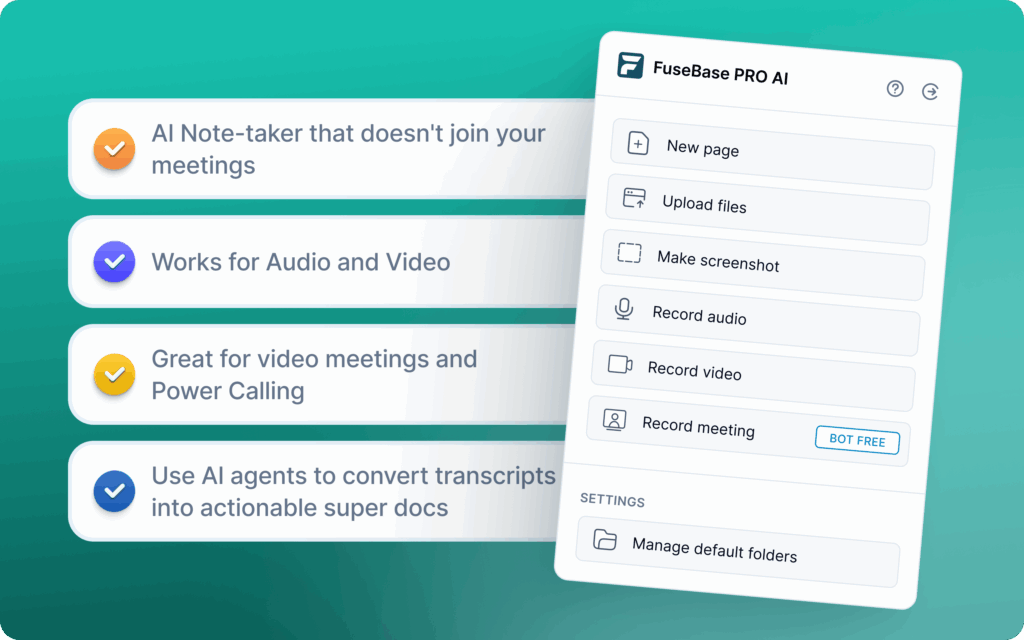
The primary motivation for developing a comprehensive tool like FuseBase was to improve customer retention and focus on sales. Yes, FuseBase is our software, and it’s more about keeping the client than purely closing the deal. FuseBase uses meeting intelligence to fuel project delivery. The main features include a Client portal, where external stakeholders can see a polished, branded recap of the communication. It separates the internal risk flags with advanced AI Agents, and you can pick up out-of-scope requests that many sales reps miss during negotiations. Unlike Gong, which can detect when a deal is stalling, FuseBase will automatically schedule a save-the-deal meeting.
Pros:
Cons:
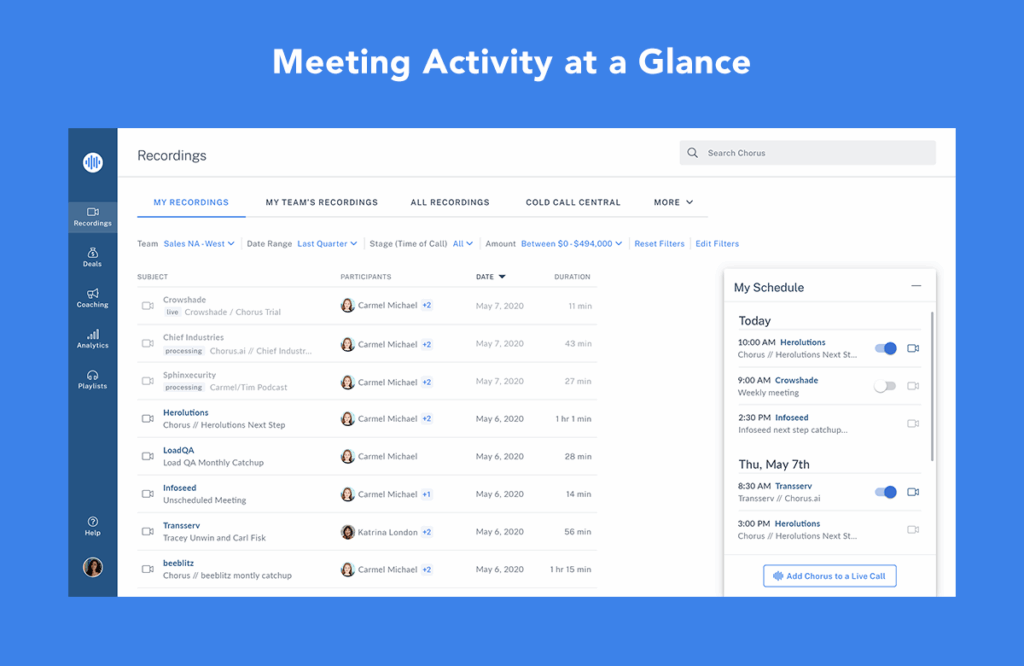
Chorus is a conversation intelligence platform, a data-rich Gong alternative, now owned by ZoomInfo. The tool is primarily used by sales, customer success, and revenue teams, and it leverages massive buyer datasets to provide context for calls and meetings. An AI tool automatically records, transcribes, and analyzes sales calls and meetings from various platforms, giving AI-generated summaries and follow-ups. One of its defining features is identifying which competitors are most mentioned across all calls.
Pros:
Cons:
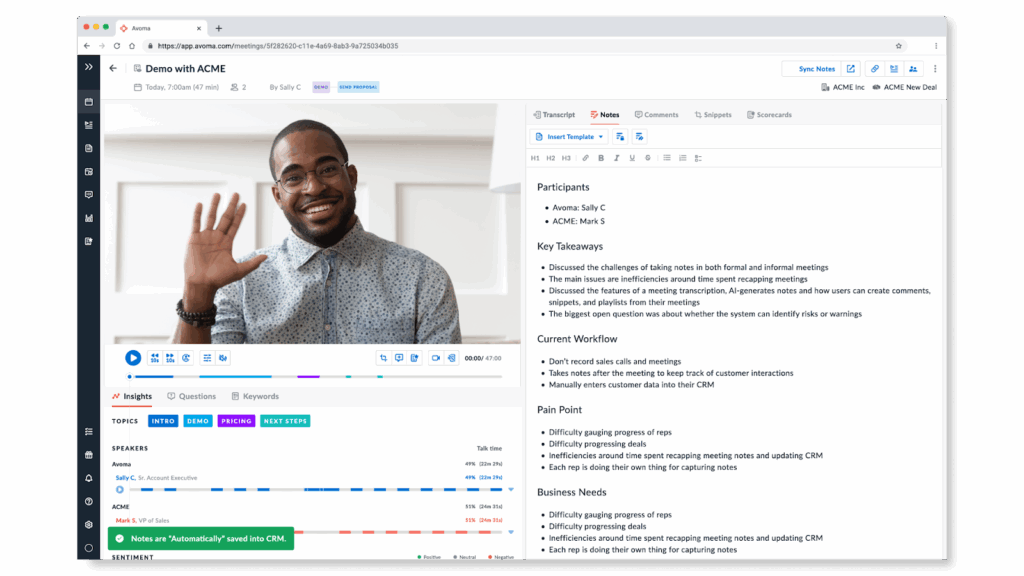
Avoma has multiple features in one tool, combining AI meeting assistance, transcription, and note-taking with conversation intelligence, scheduling, and revenue intelligence. The platform is for professionals and teams needing automated documentation and actionable insights from their meetings and other conversations. Avoma turns meetings and calls into a searchable database with summaries and action items, and it includes CRM integrations.
Pros:
Cons:
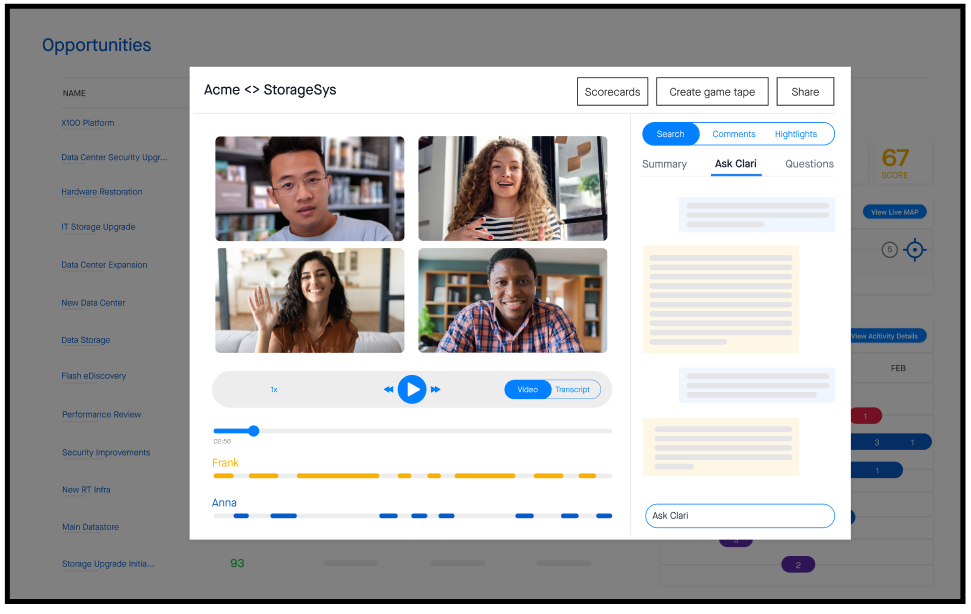
Clari Copliot is an AI-driven conversation intelligence tool that acts as a sales assistant and is part of the broader Clari Revenue Platform. You can integrate calls and meetings directly into the Clari platform to get structured pipeline and revenue signals. Automatic transcription and analysis help sales teams to act on insights in real time. It is best for sales managers and junior reps who need real-time help.
Pros:
Cons:
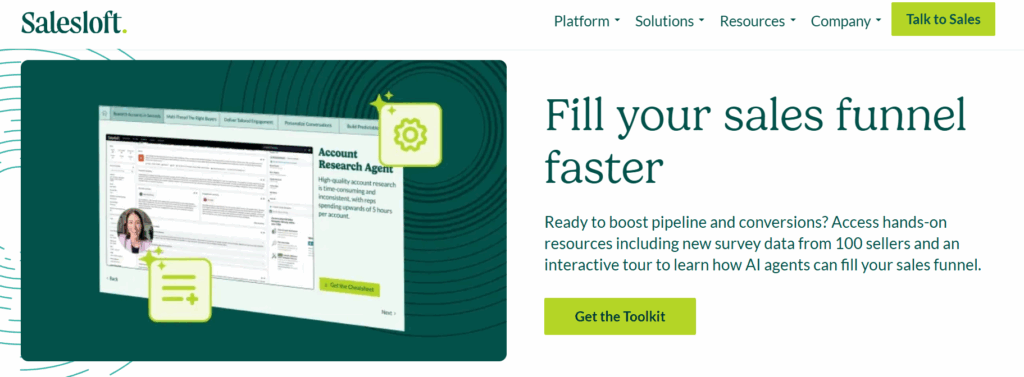
Salesloft and Clari officially merged recently to create a predictive revenue system. Salesloft is one of the leading sales engagement and revenue orchestration platforms. Platform started as a sales development tool, and it now supports sales outreach, analytics, deal management, and forecasting. Another feature Salesloft offers is AI workflows. It is a multichannel platform for automating outreach. The AI component can detect buyer signals and create a priority task list. Users get transcribed and recorded meetings, and an AI summary, but Salesloft builds on that with a real-time sales forecasting feature that relies on engagement signals from communication and pipeline data.
Pros:
Cons:
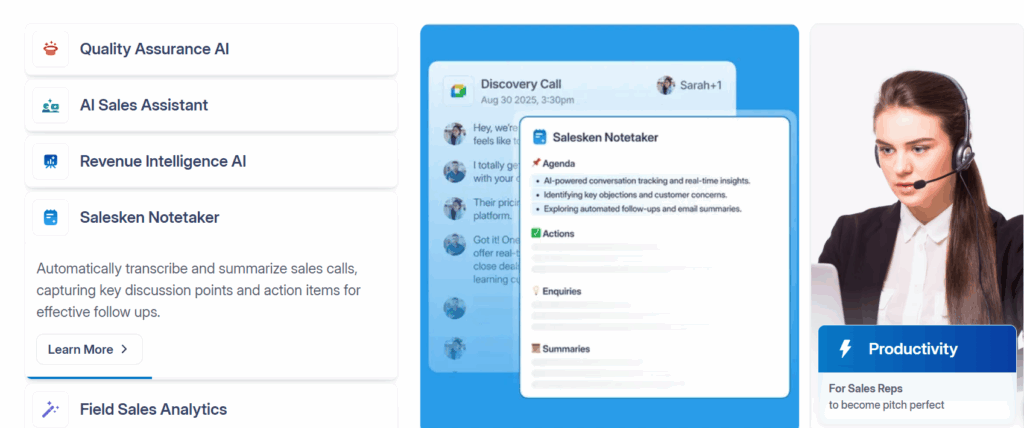
Salesken is a tool that fits into real-time coaching, along with Clari Copilot, with a stronger focus on high-volume and SMBs rather than on Clari’s Enterprise focus. As a sales intelligence tool, it analyzes conversations from different sources and provides insights. This AI tool can detect stalled and at-risk opportunities you can lose if you don’t react. Along with the baseline of call/meetings summaries, Saleskin will provide actionable items and draft follow-up messages. It’s best for indie sales and call-center teams that have high-volume tasks.
Pros:
Cons:
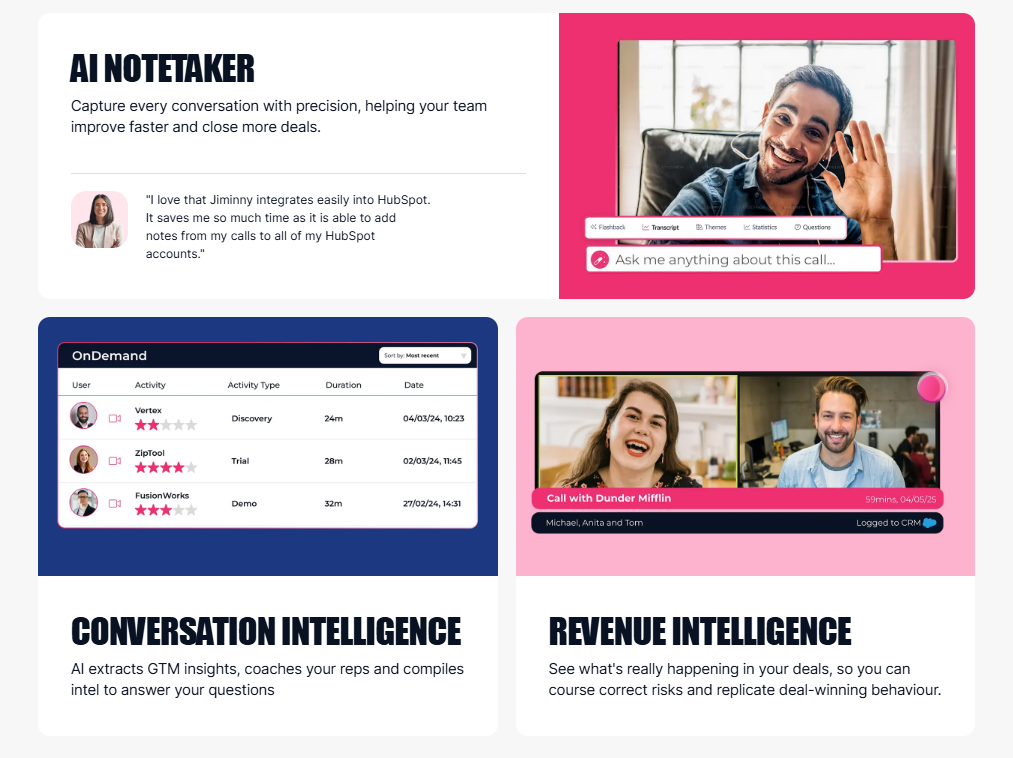
Another AI conversation and revenue intelligence platform for the sales team to help with sales, revenue, and customer success. Jiminny captures data from a wide range of calls, meetings, emails, and other interactions and utilizes AI to transcribe and summarize it to data-driven insights. It’s best for SMB teams as it provides coaching and insights into deal outcomes. You can close more deals, and it includes revenue intelligence features that highlight deal risk, stalled opportunities, and offer key next steps. It also comes with CRM integrations.
Pros:
Cons:
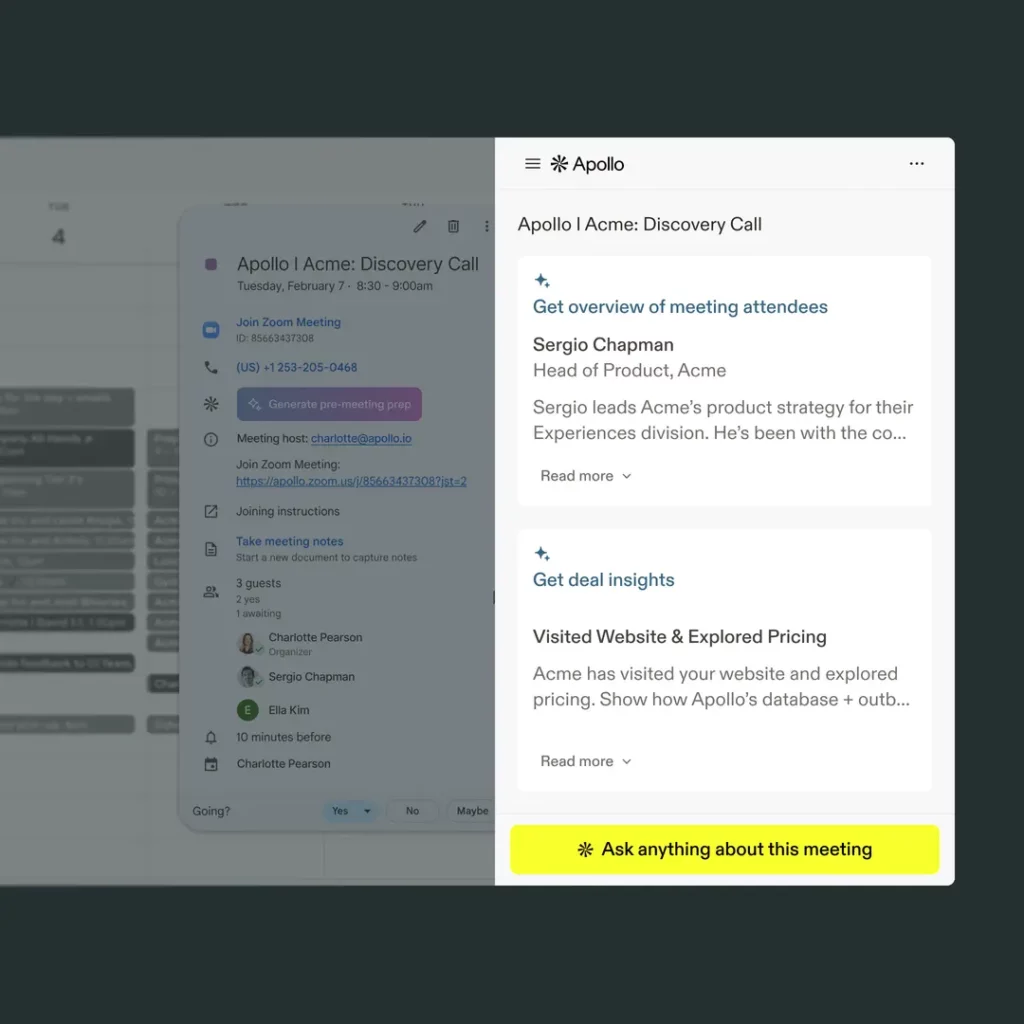
Apollo is a B2B sales engagement and revenue acceleration platform that excels at lead generation and prospecting rather than at revenue intelligence. It’s best for sales teams in B2B companies, stage sales teams, and founders. Most users opt for Appoo for its huge contact and company database. This tool has millions of verified email addresses and phone numbers. You will also get buyer signal detections, and your sales team can use the extensive data for an automated engagement campaign.Apollo offers revenue performance monitoring, pipeline health, and CRM integrations.
Pros:
Cons:
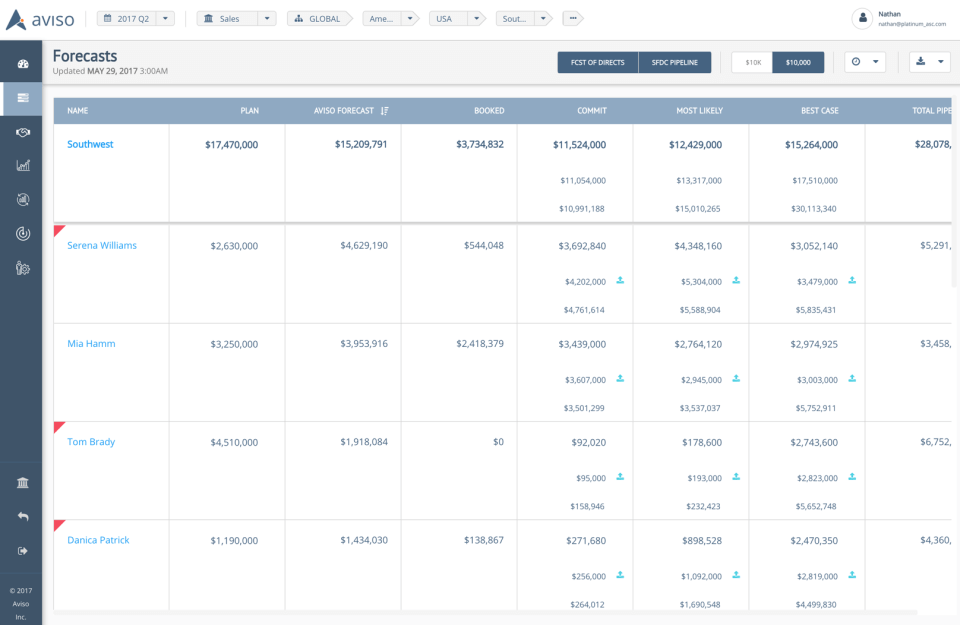
Aviso is a revenue operating system and intelligence platform for sales, marketing, and customer success teams. This tool has a single view of data from different sources, such as CRM, emails, and meetings. Aviso uses AI for insights from available data. You can also get forecasts and coaching advice. Sales reps can track deal momentum and risks, and get next-best actions advice. It is an actual revenue OS, and it’s best suited for Enterprise users.
Pros:
Cons:
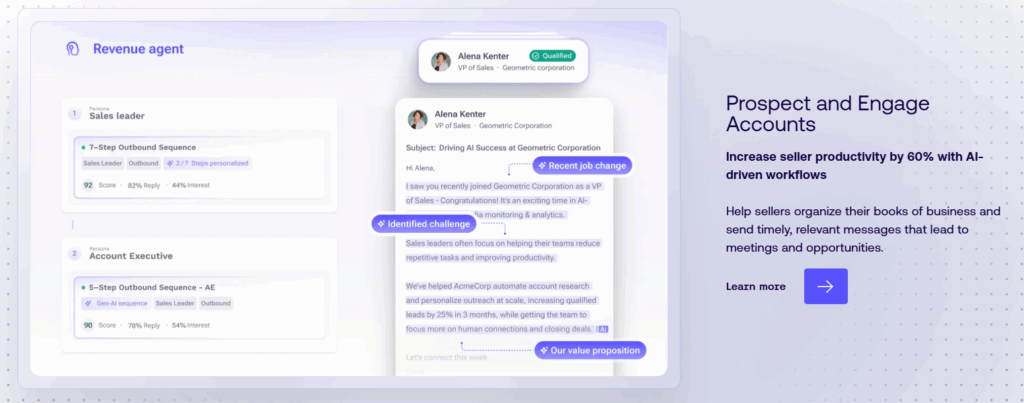
Outreach.ai is a complex sales execution platform that uses AI for sales engagement and revenue workflow. It is best suited for Enterprise teams. You can use it to automate and optimize stages of the selling process from prospecting to pipeline management and forecasting. Aside from AI workflows and CRM integration, Outreach can also be helpful for coaching, with AI-powered reports and pipeline management.
Pros:
Cons:
The idea behind revenue intelligence is to use AI for forecasting. In the last five years, tools have offered the ability to record everything (meetings, calls, emails, conversations…), so that their AI can tell you what will happen. In 2026, relying solely on deep forecasting and deal inspection to get the signature will not be enough. Post-sales teams need automated execution and governance to keep the clients.
If you want to replace Gong with an alternative solution, you might be missing the gist of the issue. Sales teams might get several wins, but if the scope creep is bleeding your margins, it won’t make much sense. Having active, agentic workflows can mean delivering more work.
If you want to see the difference between a sales tool and a client operating system, Try FuseBase.
Found it useful? Share the article with your community
Get weekly tips and insights on how to grow your business